




















How to decorate a bedroom: ideas and colour schemes
A bedroom is the one room in the house that doesn’t have to impress anyone. It only has to help you sleep. That single idea settles most decorating decisions for you: softer colours, fewer things on show, better light and a bed you actually want to get into.
Whether you’re starting with bare walls or you just want the room to feel calmer than it does now, here’s how we’d approach it and the pieces we’d choose along the way.
- Start with how you want the room to feel
- Choose a calming colour scheme
- Make the bed the focal point
- Layer texture rather than adding clutter
- Get the lighting right
- Bring in natural materials and plants
- Choose artwork that calms
- Keep surfaces clear
- Finish with scent and small comforts
- More bedroom styling ideas
- Bedroom decorating FAQs
Start with how you want the room to feel
Before choosing a colour or ordering a lamp, decide what you want to feel when you open the door in the evening. Most people arrive at some version of the same answer: calm, warm, uncluttered and quiet. It’s worth writing down, because it becomes the test for every decision that follows. A bold wallpaper you loved in a showroom may not pass it. A bedside table with closed drawers instead of an open shelf probably will.
It also helps to be honest about how you actually use the room. If you read in bed, lighting matters more than artwork. If you’re getting dressed in the dark at six in the morning, storage and clear floor space matter more than a statement chair in the corner. Decorating a bedroom well is mostly about removing friction from the hours you spend in it.


Choose a calming colour scheme
Bedrooms suit a narrower palette than the rest of the house. Two or three colours, repeated across different materials, will appear considered. Five just look busy. Pick one dominant tone for the walls and large surfaces, one supporting tone for bedding and curtains, and one accent used sparingly in lamps, frames and hardware. Four bedroom schemes that work reliably:
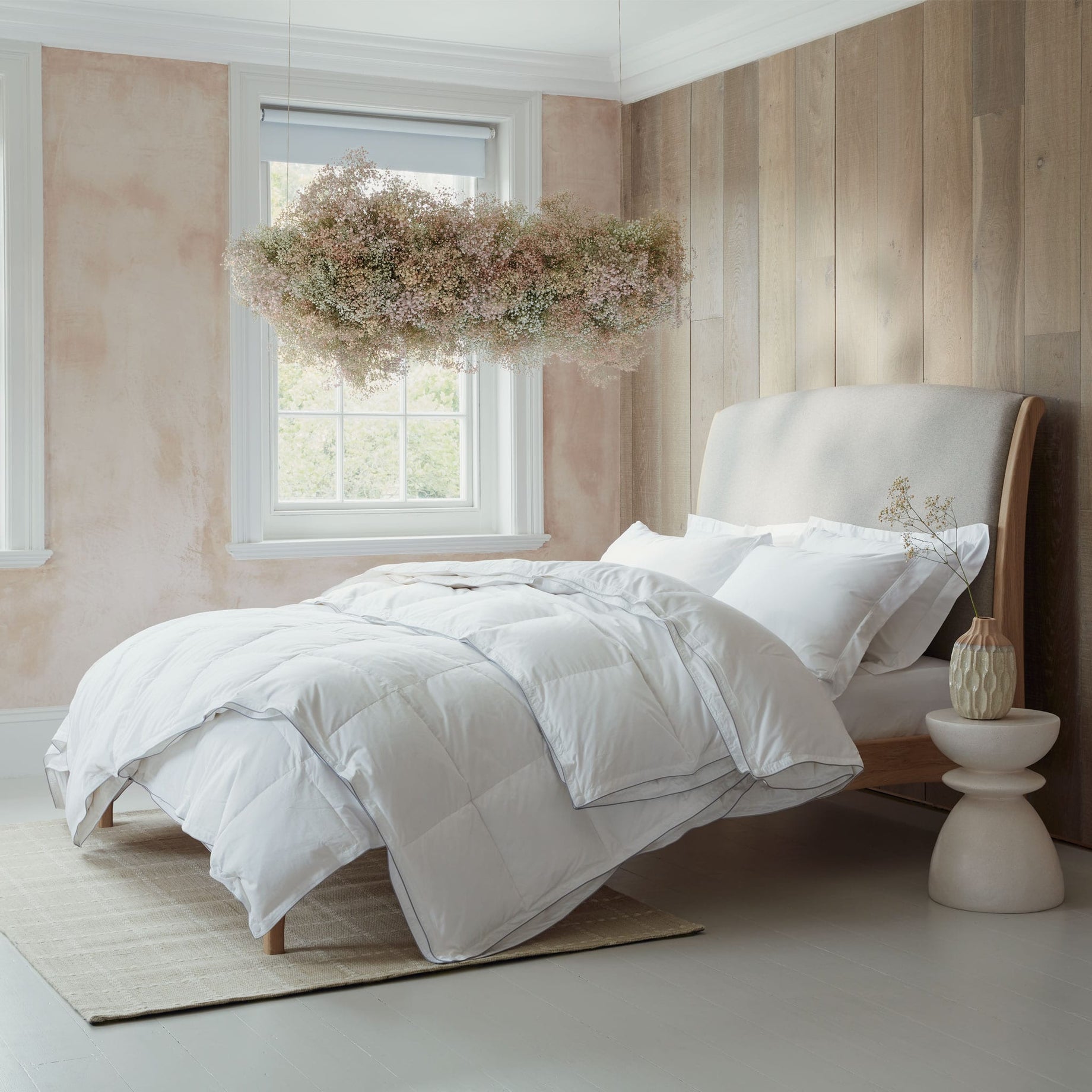
Whites and off-whites
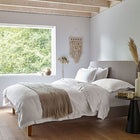
A near-white room is the most forgiving place to start and the easiest to live with over years. The risk is that it feels cold. Avoid that by mixing warm and cool whites rather than matching everything exactly and by bringing in a wooden floor, a natural rug or a grey upholstered headboard to break up the brightness.
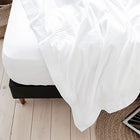
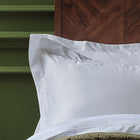
White bedding is what makes this scheme work rather than what makes it bland. Our Egyptian cotton sateen has enough sheen to catch the light and give the bed some depth, while percale stays flatter and crisper - closer to a luxury hotel.
Blush, rose gold and warm pinks
Soft pink is one of the most restful colours you can put in a bedroom, partly because it flatters the light at both ends of the day. Keep it muted, think plaster and clay rather than anything sugary and pair it with white linens, raw wood and a single metallic accent in a lamp base or a picture frame.
Natural wood finishes work particularly well here, so choose side tables, bed frames and furniture in their plainest state. Pink linen bedding does most of the work without you having to repaint, which makes this an easy scheme to try before committing to it.
Greens and natural tones
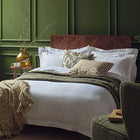
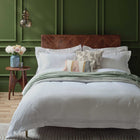
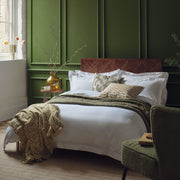
Green works well in a bedroom; we love that natural feel it has. Deep greens look beautiful on panelling or a single feature wall behind the bed; softer sage and olive suit a whole room. Both want natural textures alongside them. A woven rug, a wooden bed frame, linen or Egyptian cotton work well. Add a few plants and the scheme almost styles itself.


Monochrome with black accents
Black in a bedroom sounds risky and usually isn’t, as long as you use very little of it. A black lamp base, a slim dark frame, black window furniture or one charcoal cushion gives the eye somewhere to settle and makes the whites look whiter.
Keep the textiles soft so the scheme doesn’t turn severe. A merino lambswool throw over pale linens is the standard fix, and it works.
Make the bed the focal point
The bed takes up most of the floor and most of the sightline, so it sets the tone of the room whether you intend it to or not. A well dressed bed can carry an otherwise plain room. A flat, thin looking one will undermine an expensive scheme. Build it up in layers.
Start with the duvet and pillows
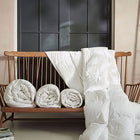
Everything else sits on top of the duvet, so its weight and drape matter visually as much as physically. Down and feather fillings fall over the edges of the bed and hold a soft, rounded shape. Synthetic fillings tend to sit squarer and flatter. If your bed looks stiff in photographs, that is usually the reason.
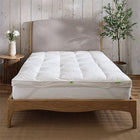
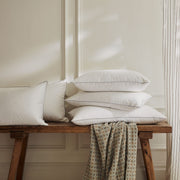
Our Hungarian goose down duvet is filled to drape rather than to sit up, and our guide to Hungarian goose down explains how tog and fill power affect both warmth and shape. Pillows follow the same logic: two plump down pillows read far better than four tired ones. If the mattress itself is the problem, a feather and down topper changes the profile of the whole bed.

Choose your bed linen
Weave changes how a bed looks more than colour does. Sateen is smooth and slightly lustrous, so it reflects light and suits richer schemes. Percale is matte and crisp. Linen creases deliberately and reads relaxed. Mulberry silk is the most decorative of the four.
Whichever you choose, a fitted sheet that genuinely fits makes more visual difference than most people expect. A loose one wrinkles across the middle of the bed and no amount of styling hides it. Check our bedding size guide against your mattress depth, and see how to choose the best bed linen if you’re deciding between weaves.
Layer with throws and cushions
Two or three cushions in front of your sleeping pillows, and one throw folded across the foot of the bed are enough. Any more and you’ll spend two minutes every night moving them onto a chair, which is how beautifully styled beds stop being styled by about week three.
A lambswool throw adds warmth and a change of texture. Keep its colour inside your existing palette rather than introducing a fourth one.


Layer texture rather than adding clutter
Texture is what adds depth to your design. Aim for contrast in materials rather than in colours: a linen curtain against a smooth painted wall, a wool rug on a wooden floor, a ceramic lamp beside crisp cotton. A wool throw on your bed. A useful rule of thumb is that every large surface should feel different from the one next to it.
This is also the answer when a room feels unfinished and you can’t say why. Nine times out of ten it’s a texture problem rather than a missing object, which is good news because it’s cheaper to solve.
Get the lighting right
Lighting is the most under considered part of most bedrooms and one of the cheapest things to fix. A single bright ceiling light doesn’t work in a room you use mainly at either end of the day.
Aim for three levels. A low overall light for the room, ideally on a dimmer. A pair of bedside lights positioned so you can read without lighting the whole room. Wall mounted lights also free up your bedside table. And something lower still for late in the evening: a small lamp on a chest of drawers, or a candle.
Use warm bulbs throughout, 2700K or below. Anything cooler makes white bedding look grey and works directly against winding down.
Bring in natural materials and plants
Wood, stone, wool, cotton, linen and paper all age well and they stop a pale room feeling clinical. Choose them in their plainest form where you can. An untreated wooden bedside table will do more for the room than a painted one.
Plants earn their place too. A few well chosen plants soften the hard lines of a bed frame or a radiator. We’ve written separately about the best bedroom plants if you’d like a list that won’t give up by February.
Choose artwork that calms
Bedroom walls suit quiet images. Something you’d happily look at while falling asleep rather than something that demands attention. Landscapes, abstracts, botanical prints and photographs all work well. Busy graphic prints and anything with large text tend not to.
Pull the colours in your artwork from what’s already in the room and the scheme ties itself together without any further effort. Hang it lower than you would elsewhere in the house, too: you view a bedroom mostly from sitting or lying down, not standing up.
Keep surfaces clear
Nothing undoes a considered bedroom faster than a bedside table carrying a charging cable, three glasses and a tower of paperbacks. Make sure everything has its proper place: a drawer or a box for chargers, a shelf for books, a hook or a chair for tomorrow’s clothes.
One object per surface is a good discipline: a lamp, a small vase, a candle. It reads as deliberate and it’s much easier to keep up than a full styling arrangement.
Finish with scent and small comforts
The last five per cent is what makes a bedroom feel like yours rather than like a photograph. A scent you associate with the end of the day does more than people expect. Our natural refillable candles come in three fragrances, and lighting one an hour before bed works as a signal as much as a smell.
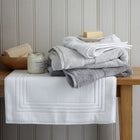
A silk eye mask if your curtains don’t quite do their job. A silk pillowcase for that bit of luxury and as a beauty treatment for your hair and face while you sleep. And fresh Egyptian cotton towels in the bathroom next door, because it’s the same instinct as a good hotel: everything soft, everything clean, nothing you have to think about.


More bedroom styling ideas
If you’d like to go further with a particular part of the room, these guides pick up where this one leaves off:
- Get that luxury hotel bed feel at home - how to build the layers a good hotel uses
- How to refresh your bedroom for Spring - a seasonal reset rather than a full redecoration
- How to make your bedroom cosy for winter - make sure your bedroom is cosy, warm and comfortable, so you can get a good night’s sleep even on the chilliest of nights
- The best bed linen bedding sets - complete sets, compared
- The best bedroom plants - what actually survives low light
Or browse our full range of luxury bed linen and duvets, pillows and toppers.


Bedroom decorating FAQs
In what order should I decorate a bedroom?
Walls and ceiling first, then flooring, then the large furniture, then bedding and textiles, with lighting and artwork last. Working in that order stops you choosing bedding to match a wall colour you later change your mind about, and it keeps the dusty jobs well away from new fabrics.
What colours are best for a bedroom?
Muted, low-contrast colours: off-whites, soft greens, warm pinks, greys and gentle blues. What matters more than the specific colour is keeping the palette to two or three tones and repeating them across different materials rather than introducing new ones.
How do I make a bedroom look expensive?
It’s almost always the bed rather than the room. A duvet with good drape, bed linen that fits properly, two plump pillows and one folded throw will lift a plain bedroom further than any single piece of furniture you could buy for the same money.
How do I decorate a small bedroom?
Keep the palette pale and consistent so the walls recede, use wall-mounted bedside lights to free up surface space, and choose furniture with visible legs so you can see the floor underneath it. Storage that goes upwards rather than outwards helps, and a smaller rug leaves more floor showing than a large one.


